Physical therapist for companies: wellbeing room models and costs
Sala, Corner, Módulo Nano or on-site visits: which model fits your headcount, shifts and space, what drives the cost and which results to measure.
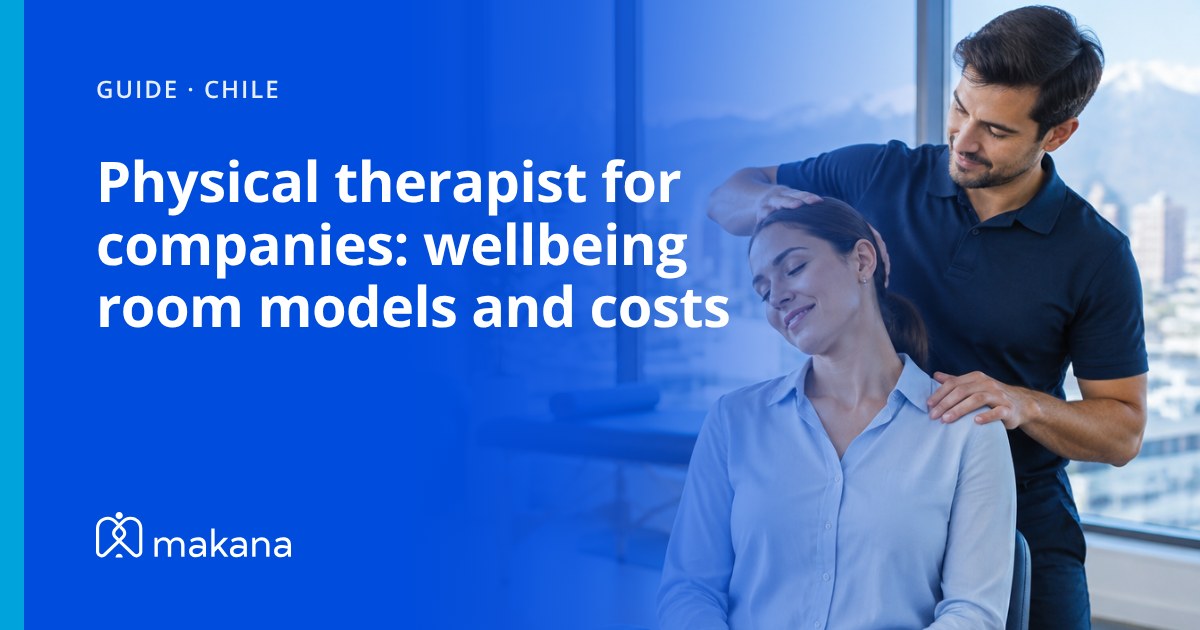
A physical therapist for companies sees your teams at the office, the plant or the remote work site; a wellbeing room keeps physical care available every day, between one visit and the next. At Makana you can hire them separately or together, in four models: Sala, Corner, Módulo Nano and on-site physical therapist visits. The cost depends on headcount, shifts, space and visit frequency.
Why hire a physical therapist for companies?
Because musculoskeletal pain is the second most common cause of reported occupational disease in Chile, and the one that costs the most workdays per case. According to the SUSESO (Chile's social security regulator) 2024 Occupational Diseases Report, 29% of occupational disease claims filed in 2024 with the mutual insurance funds (mutuals) and the ISL (Chile's public occupational insurer) were musculoskeletal diagnoses, behind mental health (52%). The same report records an average of 40.8 lost days for each musculoskeletal occupational disease at the mutuals, excluding COVID-19: the highest average of any diagnosis group.
Those figures only count what reached the mutual. The low back pain that ends in regular sick leave, the shoulder that drags on for months and the operator who slows down at the end of the shift don't show up there. That is the ground of preventive physical therapy: before the discomfort turns into sick leave.
Regulation also pushes in this direction. Decreto Supremo 44 (Supreme Decree 44), published on July 27, 2024 and in force since February 1, 2025, replaced decrees 40 and 54 of 1969. Its article 7 requires every employer to build a hazard identification and occupational risk assessment matrix that includes ergonomic risks, and its article 8 requires a preventive work program built from that matrix, with measures, deadlines and owners. Makana does not replace that matrix or that program. If your matrix flags repetitive work, awkward postures or manual handling of loads, on-site physical therapy provides tools that help mitigate that underlying musculoskeletal risk.
What physical therapy and wellbeing room models are there?
There are two ways to bring physical therapy into a company, and they work best together. One is a person who visits on a fixed schedule. The other is a space with equipment that people use without booking anyone, guided from the app. The space comes in three sizes.
Sala Makana
A room dedicated to physical recovery, with equipment for several people at once and protocols guided from the app: chair, compression, percussion and routines for the neck, back and legs. Each person checks in with a QR code. It works when many people share one site or when long shifts have a fixed break time.
At Ultraport Mejillones, the room became part of the operational cycle of 7x7 shifts, to reduce drowsiness and musculoskeletal discomfort among tractor-trailer operators (Ultraport case).
Corner
A compact station installed where the work happens: an office hallway, a plant entrance, a vessel. It includes percussion, heat, compression and cold protocols, step by step in the app. It is the format for when there is no free room or people are spread across several floors.
Módulo Nano
It sits on a table. It is the entry format: for a small team, a secondary site or an activity where you want to test usage before setting aside a fixed space.
On-site physical therapist visits
Physical therapists from the health team visit your teams on a recurring basis at the office, the plant or the remote work site. They provide care and run activities at the workplace. The company receives aggregated information (participation, body areas treated, progress by team), never an individual's data.
How usage gets activated
Installed equipment does not get used on its own. That is why the program is activated on site with internal communications ready for your channels, printed materials at the workplace, internal ambassadors and the physical therapist visits themselves, which bring people back to the room.
How much does a physical therapist for companies or a wellbeing room cost?
There is no single rate, because each model is priced on different things. What moves the price:
- Headcount: how many people will have access to the app and the equipment.
- Shifts and sites: a plant with three shifts needs more visit hours and more equipment than an office with a single schedule.
- Space: the Sala needs a dedicated space; the Corner and the Nano fit where there is no room.
- Visit frequency: weekly, every two weeks or monthly, and how many physical therapist hours per visit.
- Location: a remote work site or a plant in another region adds travel.
In the demo we put together a quote with your numbers. To compare it with what you lose today, set it next to last year's sick leave days from musculoskeletal causes.
What results can you expect?
The strongest data point comes from the Universidad Católica study with ANID support: people who use Makana at least once a month have 17.5% less absenteeism than a control group. The condition matters. The effect shows up in people who use it, so the result depends on how many people take part.
That is why cases are read by participation. At the Mowi Chacabuco plant in Aysén, the wellbeing program reached 70% participation and the plant closed 2025 with 0% accidents, a historic milestone (Mowi case).
At Marsh, the program reached 80% daily adoption (Marsh case). At Itaú, with wellbeing blocks on every floor, the program added 400+ sessions in the first month (Itaú case). Each company reports its experience in its own context: these are results of those programs, not a promise for yours.
How to choose the model, step by step
- From your risk matrix, pull the jobs with repetitive work, awkward postures or load handling, and how many people are in each one.
- Gather the baseline: claims and sick leave days from musculoskeletal causes over the last year.
- Look at the space available: if there is room for one, a Sala; if not, a Corner per floor or per line, or a Nano to start.
- Set visit frequency according to shifts: the physical therapist has to overlap with the night shift, not just with office hours.
- Agree from the start on what you will review each month: participation, areas treated and sick leave from that cause.
- After three months, adjust: more visits where pain is concentrated, a different format where usage is low.
Frequently asked questions
Does a physical therapist at the company replace the mutual?
No. A work-related injury or illness is treated and rehabilitated by the mutual or the ISL, under Ley 16.744 (Law 16,744); the on-site physical therapist works on prevention and on discomfort that is not yet an injury.
Can I hire only the room, without visits?
Yes. Each pillar is hired separately and you can add parts over time; the app and Alma also work without a physical space.
How long does installation take?
It depends on the format and the space, and it is defined with your team in the demo. A Sala needs a dedicated space and is coordinated with your facilities team.
What does the company see of the health data?
Only aggregated, anonymized information: participation, areas treated and progress by team. Never an individual's data.
Does it work for night shifts or remote work sites?
Yes. The Sala and the Corner are used without booking anyone, within the shift: at Ultraport Mejillones the room became part of 7x7 shifts, to reduce drowsiness and musculoskeletal discomfort among tractor-trailer operators. And the health team visits teams wherever they are, at the office, the plant or the remote work site, across Chile.
The next step
Come to the conversation with two numbers: headcount per shift and the square meters you have free. With that, we propose a model and a quote in a 30-minute demo. See the models for companies.
Clinical review: Makana Team (internal review; physical therapy: Kai Horwitz, physical therapist). Last reviewed: October 17, 2026.