Active breaks at work: what the rules require and how to do them
What DS 594, the Labor Code and Protocolo TMERT V3 say about breaks, and how to organize them on 7x7 and 4x4 shifts and at the office.
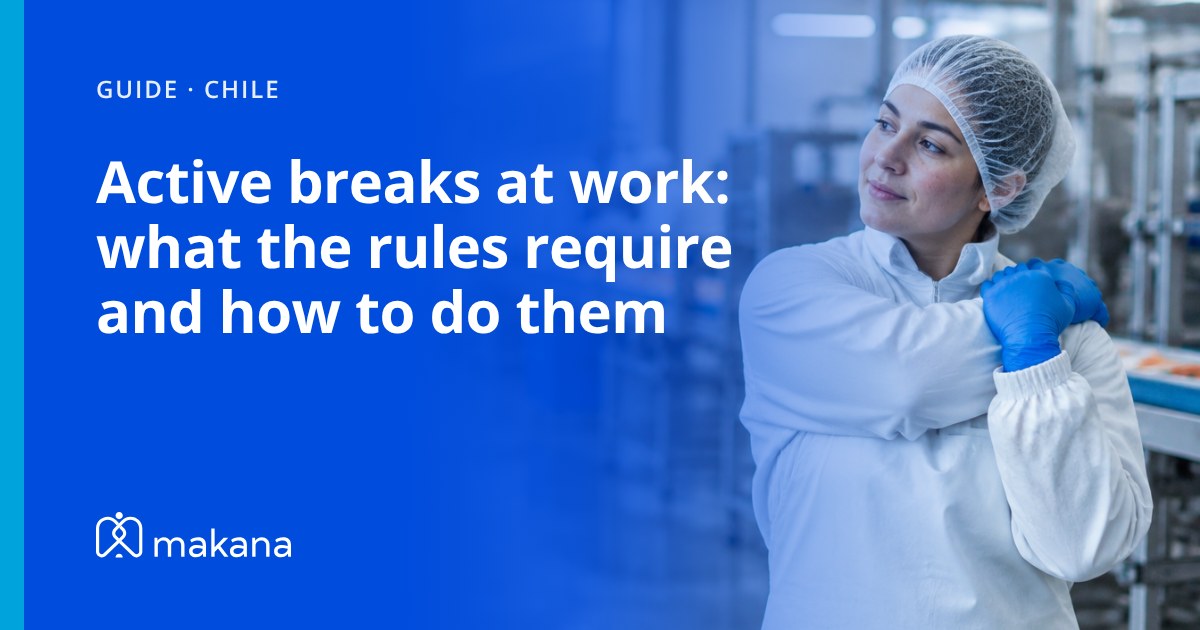
Active breaks at work are scheduled interruptions of a few minutes during the workday, to move the parts of the body that a job keeps still or overloads. No law requires them for everyone, but data entry work, call centers and the Protocolo TMERT do call for breaks, and each shift needs them in a different order.
Are active breaks mandatory in Chile?
For all workers, no rule imposes them under that name. For some jobs, there are mandatory breaks, and for the rest, risk regulations make them a hard measure to avoid.
For data entry, article 95 of the Ministry of Health's Decreto Supremo 594, DS 594 (Chile's workplace health and safety decree), on sanitary and environmental conditions in workplaces, sets a maximum of 8 hours a day and 40 a week of data entry, and a five-minute rest after every 20 minutes of continuous data entry.
In contact centers, article 152 quáter C of the Código del Trabajo (Labor Code) gives operators on continuous connection a ten-second interruption between calls and rest periods that add up to 30 minutes per workday, which cannot be split into blocks shorter than 10 minutes and count as time worked for all legal purposes. The Dirección del Trabajo (Chile's Labor Directorate) explains this in its Opinion ORD. No. 2889/27 of October 26, 2020.
In any job with repetitive upper limb work, the Protocolo TMERT V3 (Chile's occupational surveillance protocol for work-related upper limb musculoskeletal disorders) asks about breaks. In table II of the advanced identification, one of the conditions for a task to be acceptable is having scheduled breaks, not counting lunch. In table VI, the critical condition table, this question appears: "Is there no more than one break (including lunch) in a 6 to 8 hour shift?". An eight-hour shift with only a meal break falls there, and a critical condition requires intervention.
And all of this goes into the risk matrix. Decreto Supremo 44 (Supreme Decree 44), in force since February 1, 2025, requires in its article 7 identifying hazards and assessing risks, including ergonomic ones, and in its article 8 turning that matrix into a preventive work program with measures, deadlines and owners. A break program with participation records is a measure you can show.
Why do they matter to health and safety teams?
Because musculoskeletal pain is the second most common cause of reported occupational disease in Chile. According to the SUSESO (Chile's social security regulator) 2024 Occupational Diseases Report, 29% of occupational disease claims that year were musculoskeletal diagnoses, behind mental health (52%), and each musculoskeletal case at the mutual insurance funds (mutuals) cost an average of 40.8 lost days, excluding COVID-19.
A break does not redesign a job. The TMERT protocol itself, in section 7, asks to prioritize engineering measures and says administrative ones work as an immediate action but should be considered a temporary solution. The active break covers the time until the job change arrives, and in jobs where no redesign is possible, it is the measure that remains.
What we see on site
The difference between a break program that lasts and one that dies within a month is where the break happens. At the Mowi Chacabuco plant in Aysén, Makana's wellbeing program reached 70% participation and the plant closed 2025 with 0% accidents, a historic milestone (Mowi case).
At Ultraport Mejillones, tractor-trailer operators work 7x7 shifts, with long periods in a static position and discomfort in the lower back, lower body and upper body. The wellbeing room became part of the shift cycle, with reactivation routines to shake off drowsiness and exercises for the wear that builds up over the days (Ultraport case).
Among people who use Makana, 1 in 3 report less physical discomfort and 1 in 4 say it went away. And among those who use it at least once a month, absenteeism is 17.5% lower than in a control group, according to a study with Universidad Católica and ANID support. The condition matters: the effect shows up in people who take part.
How to build an active break program, step by step
- Start with your DS 44 risk matrix and your TMERT identification: list the jobs with repetitive work, awkward or static postures and load handling, and how many people are in each one per shift.
- Define the body area for each job. An operator seated for 12 hours needs the lower back and legs; someone filleting or packing, the shoulder, forearm and wrist; someone in front of a screen, the neck and wrists.
- Put the break in the shift schedule, at a fixed time and a fixed place. A break "when there's time" does not show up in the records or in TMERT table II.
- Choose who leads it: a trained internal monitor or a routine on the phone; the on-site physical therapist helps adjust the exercises to each job. What cannot be missing is someone responsible for making it happen on every shift, including the night shift. Anyone with an injury or pain that does not go away skips the general routine: a professional evaluates them and, if the cause is work-related, refers them to the mutual or the ISL (Chile's public occupational insurer).
- Record every break from the first week: date, shift, area, time, who led it and how many people took part. That backs up the measure in the DS 44 preventive work program, and you can present it to the Comité Paritario (joint health and safety committee).
- Review every six weeks: where participation drops, which areas still hurt and which jobs need a different measure.
How do you do active breaks on 7x7 and 4x4 shifts and at the office?
The shift changes three things: how long the workday is, when night falls and how much builds up from one day to the next. The physical therapist adjusts the specific exercises in each routine to the job; what follows is how to schedule the breaks.
12-hour 7x7 shift
Twelve hours goes well beyond the 6 to 8 hour shift that TMERT table VI looks at, so a single break on top of the meal break falls short. Spread scheduled breaks across the shift, not only at the start. The first one is a warm-up before the task; the ones in the second half are for a body that has spent hours in the same position.
A starting grid, to be adjusted later with the physical therapist for each job: one break at the start of the shift, another before the meal break, another past the middle of the workday and a last one in the final two hours, each about 10 minutes. Write it into the shift program, with time and place, so the supervisor can enforce it.
On the night shift, the early morning break is for reactivation: stand up, move and step out of the cab or workstation. It is the one Ultraport uses to shake off drowsiness and get back to operations. And since wear builds up, the last days of the work week are the ones where it matters most that the break is not skipped.
4x4 shift
If your 4x4 is also 12 hours, the same applies as for the 7x7 within each workday. The difference is in the cycle: there are fewer consecutive workdays, but the frequent switch between work and rest days, and between day and night shifts when the system rotates, makes the routine easy to lose. It helps if the break is always at the same time in the shift and in the same place, and if the routines are on the phone so the team can follow them no matter who is on shift.
Office and screen work
If the job involves continuous data entry, article 95 of DS 594 already sets the break: five minutes for every 20 of continuous data entry. For the rest of computer work, TMERT V3 table III asks whether head flexion is under 25° and whether extreme wrist deviation is absent. An office break targets those two areas: neck and shoulders, forearm and wrist, and getting up from the chair.
At the office the problem is rarely space: it is that the break competes with the next meeting. It works better when the team calendar reserves it and when a reminder, in the app or in the calendar, suggests it at the same time.
How to tell if the program is working
Look at three things every month. Participation by shift, because a program that reaches the day shift and not the night shift leaves out the people who need it most. The body areas where people report discomfort, to adjust the routines. And sick leave days from musculoskeletal causes, against the previous year's baseline, which is the number you will be able to show management.
Frequently asked questions
How long should an active break last?
There is no general duration set by law. For data entry, DS 594 sets five minutes for every 20 of continuous data entry.
Does an active break count as time worked?
For call center operators, article 152 quáter C of the Labor Code says so explicitly. For other jobs, it is best to define it in the internal regulations with your labor advisor.
Are active breaks enough to comply with TMERT?
Not always. Section 7 of the protocol prioritizes engineering measures; in a job in critical condition, the break goes along with the redesign and does not replace it.
Who should lead the breaks?
A trained internal monitor, with support from a physical therapist to adjust the routine to the job. What matters is having one person responsible per shift and a record of who takes part.
Do active breaks work for remote work?
Yes, with a routine on the phone or computer and a fixed time on the calendar. If the person does continuous data entry, the article 95 break in DS 594 applies just the same.
The next step
Your company organizes the breaks; Makana provides what helps sustain them: rooms to recover within the shift, physical therapists who visit your teams at the office, the plant or the remote work site across Chile, and an app with five modules (Mental Health, Nutrition, Fitness, Finance and Community) that supports each person. Come to the conversation with your headcount per shift and the jobs your risk matrix flagged. See how we work with companies.
Clinical review: Makana Team (internal review; physical therapy: Kai Horwitz, physical therapist). Last reviewed: October 18, 2026.